Friday, November 13, 2015

Bat Time: review of THE SECRET LIVES OF BATS, by Merlin Tuttle

The Secret Lives of Bats
Merlin Tuttle
$26.00, hardcover; our price $20.80
Click Here to Purchase


As Rogers & Hammerstein wrote in South Pacific, “You’ve got to be taught/to hate and fear….” Apparently, too many humans have been taught to hate and fear bats. The result of ignorance is often irrational hatred; the result of hatred is violence. Bats have suffered human violence for centuries, in spite of their vastly beneficial role in nature as insect eaters and fruit and flower pollinators.
 Starting in the 1970s, there was a definite movement towards not only tolerating but protecting these much maligned creatures. That movement is largely the result of the work of Dr. Merlin Tuttle. His passionate research led to the founding of Bat Conservation International that has succeeded in protecting and reinvigorating threatened bat populations worldwide.
His passion for bats began as a teenager in Tennessee when he discovered the behavior of gray myotis bats was decidedly different from what he’d read in books. The fact that he, at age seventeen, had possibly made a significant observation compelled him to further his scientific studies. In so doing, he also became a skilled photographer who would not let danger or any discomfort dissuade him from the perfect shot.
In working with National Geographic Dr. Tuttle’s expeditions have taken him all over the world, and subjected him to almost inhuman amounts of physical and emotional hardship, all of which he recalls with extraordinary good humor. He seems to possess not only Herculean strength and resilience, but a diplomatic personality that never condemns or judges those who have perpetrated harm on bats. Upon visiting Bracken Cave in Texas to witness firsthand the world’s largest bat colony, Tuttle is nearly overcome by the heat and carbon dioxide, even with his respirator. Beetles crawl up his legs, biting him, and he feels the first indications of losing consciousness. Fainting would be deadly, so reluctantly he retreats.
Upon leaving the cave, he encounters three men sitting in the shade, talking:
They were speculating on how much fun it would be to sometime throw a stick of dynamite into the cave and see how many bats would come out all at once. Of course, the answer was none. They’d all be dead. These men weren’t maliciously inclined. They were simply ignorant and were quite apologetic when I explained the consequences of such an act….
The appalling spectacle of how easily the world’s largest remaining bat colony could be destroyed by simple ignorance provided a strong reminder of just how important public education could be.
Bats are fragile creatures, easily taken down in the hundreds, thousands, millions, by human intervention. Many species are already extinct because of human action and loss of habitat. Now the notorious white-nose syndrome is killing many colonies in this country. Thanks to Dr. Tuttle and others who have fought for their protection, there are some species who are making a comeback, but there is still a long way to go.
Whatever your feelings about bats, this is a highly entertaining and mind-altering plunge into their world. The color photographs are particularly awe-inspiring. Bats can be cute! They can also have faces only a mother bat would love. But they will never be evil, blood-sucking, hair-entangling creatures we’ve somehow cursed them to be. Next time you see a bat, thank him for the insects he’s eating or the fruits and flowers he’s pollinating. And leave him alone.

Friday, November 6, 2015

Dawn of the horse: review of THE HORSE: THE EPIC HISTORY OF OUR NOBLE COMPANION


THE HORSE: THE EPIC HISTORY OF OUR NOBLE COMPANION
Wendy Williams
$26; our price: $20.80, hardcover, with photos


Long before they were useful to us for work, war, or entertainment, horses have fascinated humankind. The famous Vogelherd horse was sculpted by admiring hands thirty-five thousand years ago. Horses seem to fill a niche in our lives. But when did this bond first form, and why? Those are the central questions journalist Wendy Williams strives to answer in her outstanding and ground-breaking book The Horse: The Epic History of Our Noble Companions. She writes:
“We must have horses and dogs and cats and other animals in our lives in order for our psyches to function as they should, just as we have to have bacteria in our guts in order to digest food.”
Other domesticated animals have changed biologically because of the process of being domesticated. Horses, for the most part, have not. The horse has evolved according to the world he inhabits, adapting as the climate changed, grasses proliferated, water ebbed and flowed. The horse we know now in North America originated 56 million years ago as the dawn horse, gradually losing his toes, developing a concave back and flat teeth. In fact, the evolution of the horse’s teeth determined his very survival, and the evolution of grass determined his teeth. Beginning as a browser, he developed into a grazer. Beginning as a scampering little creature, he became a galloping athlete. His intelligence, along with his physical prowess, also grew.
Because of horses’ unique intelligence (dawn horses had advanced brains, according to paleontologists), as well as social and emotional commonalities with humans, behaviorists are able to conduct tests to determine horse perception. It’s been revealed that horses can interpret two-dimensional images, much as humans can. And although they are far-sighted and partially color blind, they recognize different human faces, even being able to tell twins apart, and, more important perhaps, perceive emotions. When we gaze at a horse’s eye, we also read his feelings. Could the Pleistocene cave artists have felt that connection as well? And perhaps in finding this bond, did a mutual trust develop even in prehistoric times? (Humans have famously abused the trust of our animal companions on too many occasions, but horses seem to have unending faith in us anyway, which just proves that they must know something we don’t.)
In searching for a deeper understanding of horses, Williams explores some of the mysteries in their evolution, including one fascinating riddle: the disappearance of the horse in the Western hemisphere, and specifically North America, around 14,000 years ago. The reasons for this vanishing are debated vehemently by scientists, and no consensus has been reached. (The fact that horses were no longer here when Europeans arrived has been used as the rationale for the government’s removing the wild mustangs in the West as a non-native species.) Darwin himself had struggled to find an answer to this phenomenon. Why, after millennia of adapting to the changing conditions, would the horse population dwindle and die out in this region? Was it the result of human activity?
Williams’ investigation of this disappearance takes her all over the world, tracking the horse’s progress and decline, along with the planet’s shifts, and coinciding human development. One particularly illuminating incident occurred in 2013 in Britain’s New Forest National Park where dozens of free-roaming New Forest ponies perished as a result of the boomer crop of acorns. Horses love acorns to death. Literally. Oak trees proliferated relatively recently, after the ice receded, so equine tolerance has not had a chance to evolve, and probably will not. Perhaps that offers one clue to the North American extinction. The controversy, however, continues to rage in the scientific community, and may never be fully resolved.
What we do know is that the horse’s extraordinary evolution occurred not to benefit mankind, or as a result of our intervention, but in spite of it. We are fortunate to have found common ground that enables a mutually beneficial relationship, and that the horse is forgiving of our many trespasses. There is still much to learn as we humans evolve into wiser, more compassionate companions.
The Horse begins and ends with the author observing wild mustangs in Wyoming. Her quest for understanding the true nature of the horse, and the origins of the bond between horse and human, provides us with a joyous ride through equine history. Williams gives us a cohesive, comprehensive, yet comprehensible study of this magnificent animal. Her Epilogue is truly an “ahhh!” moment of personal evolution.
Click Here to Buy Book

Friday, October 9, 2015

Heroes and Angels: review of RESCUE ROAD: ONE MAN, THIRTY THOUSAND DOGS, AND A MILLIION MILES ON THE LAST HOPE HIGHWAY


Peter Zheutlin
$14.99, paperback. Our price: $12

 
There are true angels among us. They are not supernatural, superhuman, or super wealthy. Instead, these angels are people who see a problem that is without ultimate solution, but they soldier on regardless, trying to solve it. If one life is saved, they tell themselves, that’s reward enough. One such angel is the subject of Peter Zheutlin’s new book, RESCUE ROAD: ONE MAN, THIRTY THOUSAND DOGS AND A MILLION MILES ON THE LAST HOPE HIGHWAY. Zheutlin writes,
The lows in rescue, I realize are matched by the incredible highs, and without one, there isn’t the other. I’ve met so many selfless, good-hearted people from all walks of life and different parts of the country, all connected by their love of dogs and willingness to go the extra miles—or a few thousand—to shepherd them along on their arduous journeys to love and safety.
The impetus for the writing of this book is, fittingly, a dog. Peter Zheutlin and his family adopted Albie from a high-kill shelter in Louisiana via labs4rescue. He learned that Albie was to be transported north via an organization called Rescue Road Trips, run by Greg Mahle (pronounced “May-lee”). Zheutlin, a journalist, decided to explore the amazing amalgamation of events leading to his own dog’s rescue. He reached out to Mahle and asked if he could ride with him over the course of a year and see for himself how rescue really works, and particularly, the place where his beloved Albie had come so close to death. He would not just be a passenger, but would help as needed. The experience was more than eye-opening. In fact, it was exhausting, exhilarating, and ultimately awe-inspiring.

Greg Mahle grew up in the restaurant business in Ohio, so he is inured to hard work, rough hours, and low pay. His wife Adella handles the back office duties to help with the ever-changing scheduling and myriad problems arising while Greg is on the road. It’s tough on the family to have him gone so much (he makes the 1000-mile trip south every two weeks), but the results are worth it. “Gotcha Day” is what Greg calls the happy end of the transport when he can hoist a previously unwanted and doomed pup into the arms of a happy adopter. Gotcha Day is what keeps him going through horrible weather, mechanical breakdowns, and personal crises. It makes it all worthwhile.
Zheutlin sees firsthand the poverty of the Deep South, particularly the Fifth Ward in Houston, and the disregard of human as well as animal life. The so-called shelters are often nothing more than brief holding cells for euthanasia. Some of the facilities have a 90% kill rate, usually targeting puppies first rather than have to fund vaccinations. Compared to shelters in the north, that seems unbelievable, but it’s a reality that rescuers know well.

The reasons for so many high-kill facilities in the south, and for the general poor treatment of domestic animals there, are complicated. There are cultural issues concerning how animals have been traditionally regarded, especially in the rural areas. There are, of course, financial issues. A family stuck in severe poverty is not likely to take measures to care for their pets. In fact, “pet” is not really a term to apply to the creatures who are forced to live their short lives outside, with no medical care or socialization. This mindset is changing slowly, thanks to educational initiatives that many rescue organizations and southern shelters are taking, but the tidal wave of unwanted, neglected, abused, and forgotten dogs still seems endless. In spite of the odds, however, rescuers such as Greg Mahle, and his colleagues in the south, push on, never taking a breath, it seems.

Now so many of those unsung heroes and angels out there have a moment in the spotlight, thanks to Zheutlin’s book. And anyone who thinks rescuing dogs means playing with puppies all day long will be humbled by the physicality and emotional strain rescuers endure.

Take this book as a call to action to not only support legitimate rescue organizations through donations and adopting, but to address the importance of education in slowly building empathy towards all living things. We can all be angels if we want to be.

To order your copy at 20% off and FREE shipping, click here!

Thursday, September 10, 2015

Invisible Dogs: review of THE BLACK DOGS PROJECT, by Fred Levy


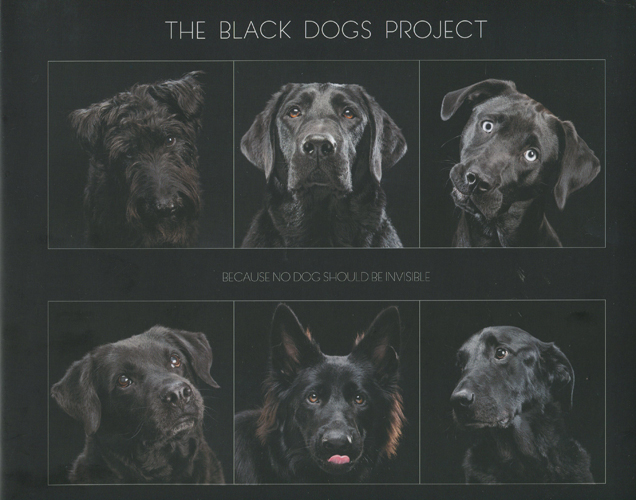
The Black Dogs Project
Extraordinary black dogs and why we can’t forget them
Photography by Fred Levy
Hardcover, $25. Our price: $20
The fickleness of humans never ceases to amaze. For some reason, black dogs are more likely to be overlooked in shelters by potential adopters, and thus more likely to be euthanized. The explanations for this phenomenon, known as “Black Dog Syndrome,” range anywhere from superstition to a sort of blind eye; black dogs simply don’t stand out as prominently as other dogs, and are thereby rendered invisible.
Fred Levy had been taking a series of photos of black dogs for the Black Dogs Project in order to help display their worth in a better light, perhaps rectifying their invisibility. Now he has encased the collection of over 50 portraits in this beautifully produced volume.
Each photo is accompanied by the dog’s bio as told by his or her human companion. All found their homes because their person was drawn to a distinctive personality, a look in the eye, or that strange, inexplicable connection we sometimes discover with another creature. One pup helped soothe fraught nerves of fire fighters after the Boston Marathon bombings. Another helped raise his human, staying with her through young adulthood and beyond as a steadfast supporter of all she did.
No dog deserves to be abandoned, abused, or neglected. If some are simply overlooked because their true beauty is hidden under a dark bushel, then Fred Levy’s wonderful work will certainly provide their much-deserved day in the sun! And if you are looking for a dog to join your household, be sure to judge by the temperament and not by the color, or absence thereof.
 

Wednesday, August 26, 2015

Dog Detective: review of SCENTS AND SENSIBILITY, by Spencer Quinn


Spencer Quinn

$25; our price $20

In this latest installment in the Chet and Bernie Mystery series “Chet the Jet” supplies us with more fast-moving intrigue as he himself struggles to understand the humans around him, especially his favorite human of all, Bernie Little, owner of the Little Detective Agency.

Returning home from their last case (see Paw and Order), Bernie and Chet are dismayed to find their safe missing, and Chet's nose confusingly picks up the scent of his best pal Iggy who lives with the Parsons across the street. What could old man Parsons have to do with this apparent theft? Bernie and Chet find out soon enough when an illegally transplanted saguaro leads to murder.

When I introduce those deprived folks who have not yet had the pleasure of reading any of the books in this delightful series, I explain the concept the way Spencer Quinn himself does: Chet the dog serves as narrator of the mysteries, and never once seems any less doglike. He is easily distracted by edibles, often finds that his tail has a mind of its own, and relies on his superior nose to help his pal Bernie do what they do best. Although a K-9 School failure (“I’d somehow flunked the leaping test on my very last day. Was a cat involved?”), Chet is Bernie’s right hand, uh, dog, and loves Bernie with an unwavering devotion.

Chet is also somewhat philosophical in his observance of human foibles and fumbles. For instance in trying to understand the meaning of skin color, he muses:

The truth is there’s not much color variety when it comes to humans, not compared to how we roll in the nation within. Take me, for example: mostly black but with one white ear, which I know on account of how many people mention it in my presence. Ever seen a human colored like me? The point is humans go on and on about skin colors when it isn’t even one of their strengths. And they have so many strengths: cars, tennis balls, bacon, and that’s just without even thinking, which is how my mind works best.

Quinn masterfully moves the story along by use of dialogue, which Chet overhears, and generally misinterprets, and with Chet’s own observations. His senses are keen, but deductive powers are, as he puts it, Bernie’s terrain. He is unable to count past two, and his knowledge of colors, especially red, is, he says, not to be trusted. But what a nose, far superior to Bernie’s, even though he admires his friend’s bountiful feature:

"One thing for sure," Bernie said. "I smell a rat."
All at once Bernie had my full attention. He had never smelled a rat before, not in any back alley, Dumpster, or landfill we’d ever investigated, almost all of them as ratty as you could wish for. Once we’d even worked our way into a sewer system. Rats out the yingyang down there, my friends. Invisible, yes, on account of the darkness, but they’d smelled the place up in a way that couldn’t be missed. But that was the point: Bernie had missed it. That was when I’d first been certain that his nose—really good-sized in human terms—was mostly for decoration. And now he was smelling a rat, when—trust me—there was no rat to smell?”

Humor aside, the action is intense. Bad guys abound and Chet is pushed almost to the brink, as is Bernie, leaving us with a cliffhanger at the end of the book. Now we shall have to wait another year for the next installment. Unlike Chet, this human finds waiting terribly difficult. With no bone to chew or tail to admire, I’m left to wonder and worry about what awaits the Little Detective Agency.

Thursday, August 20, 2015

The Runaway: review of LET THE TORNADO COME, by Rita Zoey Chin


http://booksforanimallovers.com/complete-list-of-books/439-let-the-tornado-come.html

2014, paperback

$15.99, our price $12.79

A drawback to amateur memoirs is the writer’s inability to tell a story, no matter how extraordinary it might be. How often, in my years in publishing, I’d hear about someone’s “fascinating” life. And yet they were incapable of relaying it with any finesse or style, thus turning a fascinating life into a dull one.

Not so with this incredible memoir, which I would place on a par with Strayed’s WILD and MacDonald’s H IS FOR HAWK. 

Rita Zoey Chin suffered at the hands of her parents and later with predatory adults in ways we in this country prefer to ignore. Instead, we incarcerate, and she suffered that as well. Her only hope was to run. So from the age of eleven on Rita ran away, sleeping in stairwells or empty cars, struggling to find food in any way possible, begging for help from friends and strangers alike. Each episode would end with her back home, being beaten again, traumatized emotionally and physically.
All of this is survivable, and she does survive, and yet at age thirty-five, happily married and living the life she had always dreamed of, she is suddenly hammered by panic attacks, which become so debilitating she’s unable to leave the beautiful house she and her husband just moved into. The runaway is hamstrung, and that immobility frightens her to death.

Chin refers to her childhood self as a runaway with a mixture of derision and pride. As a young girl, she hears the sound of hoofbeats in her mind, and longs for the wild, galloping freedom they represent. But when she meets the horse who will become her salvation in many ways, he is himself troubled by a possibly rough past, and certainly by some untreated physical ailments. Claret requires a presence of mind on Rita’s part, with precludes running away or freezing in panic. When he spooks at falling ice in the barn and tosses her to the dirt, he returns to her and puts his nose down on her helmet. His breath reassures her and she climbs on him again—a major accomplishment for this runaway rider and for her fearful horse. It’s clear they need each other, and that the bond between horse and woman is stronger than the trauma they both have faced: “… I stood beside him in the paddock and looked up at the pine trees. He seemed to be looking, too, both of us standing so still. Sometimes a breeze would flutter his mane, and I’d think, You wild, wild thing.”

As with Helen MacDonald, Rita Zoey Chin is a poet, and her sense of lyricism and rhythm is prominent throughout the book. But she’s as much a storyteller, compelling us to read, even as we cringe at the monsters she faced. We know she made it out alive and well, and we know the mutual devotion she shares with Claret will beat off the panic they both confront. How such broken lives are mended is what propels the reader. This fascinating life makes for a fascinating read.

Thursday, August 6, 2015

First Dog: review of THE DOG MASTER, by W. Bruce Cameron


The author of the celebrated A DOG’S JOURNEY and A DOG’S PURPOSE, among other fine books, W. Bruce Cameron here offers a novel set in the Paleolithic era, about 30,000 years ago, when climate change was threatening modern man with imminent extinction. Starvation forced human tribes to fight each other as well as wild predators for the rapidly diminishing or migrating prey. Humans needed every angle to survive, from weaponry to cunning. Biologists and archeologists have demonstrated that the most important element of our survival and evolution was domestication of plants and animals, and perhaps above all, wolves. Domestication and artificial selection not only saved our species from doom, but have altered our own biology substantially.
THE DOG MASTER unfolds with mankind divided into tribes, including one called Wolfen, who worships wolves, paying tribute by offering them food, and mimicking their ways. Wolves were their gods, not their enemies. Spirituality and art were just beginning to surface in this era. The Wolfen represent early devotees.
Another tribe, the Kindred, is organized by sex: the men as hunters, the women as gatherers and in charge of marriages and any domestic issues. One woman heads the council, and thereby holds much political clout. Through her brutal pursuit of power, the council leader banishes a crippled child of her most hated adversary, claiming his disability is proof of a curse upon the tribe that has led to the decreased hunting. Mal, the banished son, eventually forms the bond with a female wolf and her pups that will change the course of his and his peoples’ lives.
Cameron’s characters in both of these tribes become intertwined, with a wolf at the center. He weaves the narrative in such an expert and enthralling pattern that one can easily forget the more fantastic elements: for instance, the communication among the people and tribes. In fact, he states as much in his very entertaining Afterword:
“With no manuscripts to study, I could only speculate on what a conversation might be like between two members of the Kindred…. For all I know they would say ‘LOL’ to each other…. I am not alone in having to guess: as I read what experts had to say about this particular era, I was struck by how current theories attract consensus and controversy, and how some dogma, accepted in the past, has fallen into disfavor.”
What experts do seem to agree on is that at some point one wolf was thoroughly domesticated by one human, and that act created an evolutionary leap. (For some really fascinating reading about evolutionary development, read DOMESTICATED by Richard C. Francis.) The wolf’s superior ability to hunt and track prey was of vital importance to human survival. But in the story, it is more than simple basic survival that brings the two species together. There grows a trust, an empathy, and a strong emotional attachment between the Kindred man Mal and his “Dog.”
I’m not generally a fan of “cave” fiction, although I did love REINDEER MOON by Elizabeth Marshall Thomas. And yet I found myself utterly enthralled and invested in each character. Once again, W. Bruce Cameron has written a brilliant novel that will certainly inspire more thought and conversation about the wolf’s role in our evolution and survival, and about animal/human codependency. But it is also just a damn good read!