Thursday, September 10, 2015

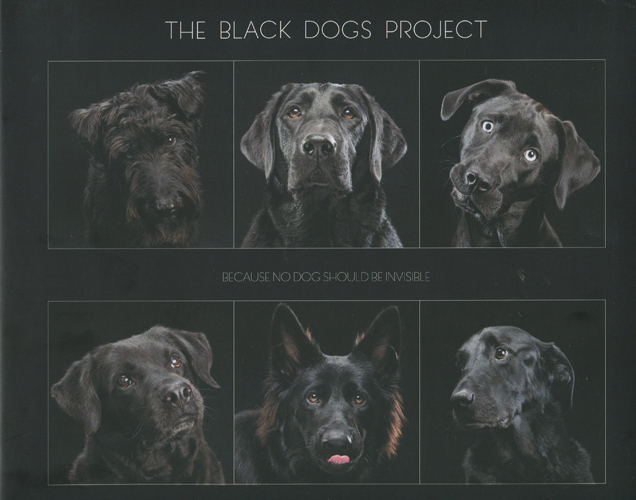
Invisible Dogs: review of THE BLACK DOGS PROJECT, by Fred Levy


The Black Dogs Project
Extraordinary black dogs and why we can’t forget them
Photography by Fred Levy
Hardcover, $25. Our price: $20
The fickleness of humans never ceases to amaze. For some reason, black dogs are more likely to be overlooked in shelters by potential adopters, and thus more likely to be euthanized. The explanations for this phenomenon, known as “Black Dog Syndrome,” range anywhere from superstition to a sort of blind eye; black dogs simply don’t stand out as prominently as other dogs, and are thereby rendered invisible.
Fred Levy had been taking a series of photos of black dogs for the Black Dogs Project in order to help display their worth in a better light, perhaps rectifying their invisibility. Now he has encased the collection of over 50 portraits in this beautifully produced volume.
Each photo is accompanied by the dog’s bio as told by his or her human companion. All found their homes because their person was drawn to a distinctive personality, a look in the eye, or that strange, inexplicable connection we sometimes discover with another creature. One pup helped soothe fraught nerves of fire fighters after the Boston Marathon bombings. Another helped raise his human, staying with her through young adulthood and beyond as a steadfast supporter of all she did.
No dog deserves to be abandoned, abused, or neglected. If some are simply overlooked because their true beauty is hidden under a dark bushel, then Fred Levy’s wonderful work will certainly provide their much-deserved day in the sun! And if you are looking for a dog to join your household, be sure to judge by the temperament and not by the color, or absence thereof.
 

Wednesday, August 26, 2015

Dog Detective: review of SCENTS AND SENSIBILITY, by Spencer Quinn


Spencer Quinn

$25; our price $20

In this latest installment in the Chet and Bernie Mystery series “Chet the Jet” supplies us with more fast-moving intrigue as he himself struggles to understand the humans around him, especially his favorite human of all, Bernie Little, owner of the Little Detective Agency.

Returning home from their last case (see Paw and Order), Bernie and Chet are dismayed to find their safe missing, and Chet's nose confusingly picks up the scent of his best pal Iggy who lives with the Parsons across the street. What could old man Parsons have to do with this apparent theft? Bernie and Chet find out soon enough when an illegally transplanted saguaro leads to murder.

When I introduce those deprived folks who have not yet had the pleasure of reading any of the books in this delightful series, I explain the concept the way Spencer Quinn himself does: Chet the dog serves as narrator of the mysteries, and never once seems any less doglike. He is easily distracted by edibles, often finds that his tail has a mind of its own, and relies on his superior nose to help his pal Bernie do what they do best. Although a K-9 School failure (“I’d somehow flunked the leaping test on my very last day. Was a cat involved?”), Chet is Bernie’s right hand, uh, dog, and loves Bernie with an unwavering devotion.

Chet is also somewhat philosophical in his observance of human foibles and fumbles. For instance in trying to understand the meaning of skin color, he muses:

The truth is there’s not much color variety when it comes to humans, not compared to how we roll in the nation within. Take me, for example: mostly black but with one white ear, which I know on account of how many people mention it in my presence. Ever seen a human colored like me? The point is humans go on and on about skin colors when it isn’t even one of their strengths. And they have so many strengths: cars, tennis balls, bacon, and that’s just without even thinking, which is how my mind works best.

Quinn masterfully moves the story along by use of dialogue, which Chet overhears, and generally misinterprets, and with Chet’s own observations. His senses are keen, but deductive powers are, as he puts it, Bernie’s terrain. He is unable to count past two, and his knowledge of colors, especially red, is, he says, not to be trusted. But what a nose, far superior to Bernie’s, even though he admires his friend’s bountiful feature:

"One thing for sure," Bernie said. "I smell a rat."
All at once Bernie had my full attention. He had never smelled a rat before, not in any back alley, Dumpster, or landfill we’d ever investigated, almost all of them as ratty as you could wish for. Once we’d even worked our way into a sewer system. Rats out the yingyang down there, my friends. Invisible, yes, on account of the darkness, but they’d smelled the place up in a way that couldn’t be missed. But that was the point: Bernie had missed it. That was when I’d first been certain that his nose—really good-sized in human terms—was mostly for decoration. And now he was smelling a rat, when—trust me—there was no rat to smell?”

Humor aside, the action is intense. Bad guys abound and Chet is pushed almost to the brink, as is Bernie, leaving us with a cliffhanger at the end of the book. Now we shall have to wait another year for the next installment. Unlike Chet, this human finds waiting terribly difficult. With no bone to chew or tail to admire, I’m left to wonder and worry about what awaits the Little Detective Agency.

Thursday, August 20, 2015

The Runaway: review of LET THE TORNADO COME, by Rita Zoey Chin


http://booksforanimallovers.com/complete-list-of-books/439-let-the-tornado-come.html

2014, paperback

$15.99, our price $12.79

A drawback to amateur memoirs is the writer’s inability to tell a story, no matter how extraordinary it might be. How often, in my years in publishing, I’d hear about someone’s “fascinating” life. And yet they were incapable of relaying it with any finesse or style, thus turning a fascinating life into a dull one.

Not so with this incredible memoir, which I would place on a par with Strayed’s WILD and MacDonald’s H IS FOR HAWK. 

Rita Zoey Chin suffered at the hands of her parents and later with predatory adults in ways we in this country prefer to ignore. Instead, we incarcerate, and she suffered that as well. Her only hope was to run. So from the age of eleven on Rita ran away, sleeping in stairwells or empty cars, struggling to find food in any way possible, begging for help from friends and strangers alike. Each episode would end with her back home, being beaten again, traumatized emotionally and physically.
All of this is survivable, and she does survive, and yet at age thirty-five, happily married and living the life she had always dreamed of, she is suddenly hammered by panic attacks, which become so debilitating she’s unable to leave the beautiful house she and her husband just moved into. The runaway is hamstrung, and that immobility frightens her to death.

Chin refers to her childhood self as a runaway with a mixture of derision and pride. As a young girl, she hears the sound of hoofbeats in her mind, and longs for the wild, galloping freedom they represent. But when she meets the horse who will become her salvation in many ways, he is himself troubled by a possibly rough past, and certainly by some untreated physical ailments. Claret requires a presence of mind on Rita’s part, with precludes running away or freezing in panic. When he spooks at falling ice in the barn and tosses her to the dirt, he returns to her and puts his nose down on her helmet. His breath reassures her and she climbs on him again—a major accomplishment for this runaway rider and for her fearful horse. It’s clear they need each other, and that the bond between horse and woman is stronger than the trauma they both have faced: “… I stood beside him in the paddock and looked up at the pine trees. He seemed to be looking, too, both of us standing so still. Sometimes a breeze would flutter his mane, and I’d think, You wild, wild thing.”

As with Helen MacDonald, Rita Zoey Chin is a poet, and her sense of lyricism and rhythm is prominent throughout the book. But she’s as much a storyteller, compelling us to read, even as we cringe at the monsters she faced. We know she made it out alive and well, and we know the mutual devotion she shares with Claret will beat off the panic they both confront. How such broken lives are mended is what propels the reader. This fascinating life makes for a fascinating read.

Thursday, August 6, 2015

First Dog: review of THE DOG MASTER, by W. Bruce Cameron


The author of the celebrated A DOG’S JOURNEY and A DOG’S PURPOSE, among other fine books, W. Bruce Cameron here offers a novel set in the Paleolithic era, about 30,000 years ago, when climate change was threatening modern man with imminent extinction. Starvation forced human tribes to fight each other as well as wild predators for the rapidly diminishing or migrating prey. Humans needed every angle to survive, from weaponry to cunning. Biologists and archeologists have demonstrated that the most important element of our survival and evolution was domestication of plants and animals, and perhaps above all, wolves. Domestication and artificial selection not only saved our species from doom, but have altered our own biology substantially.
THE DOG MASTER unfolds with mankind divided into tribes, including one called Wolfen, who worships wolves, paying tribute by offering them food, and mimicking their ways. Wolves were their gods, not their enemies. Spirituality and art were just beginning to surface in this era. The Wolfen represent early devotees.
Another tribe, the Kindred, is organized by sex: the men as hunters, the women as gatherers and in charge of marriages and any domestic issues. One woman heads the council, and thereby holds much political clout. Through her brutal pursuit of power, the council leader banishes a crippled child of her most hated adversary, claiming his disability is proof of a curse upon the tribe that has led to the decreased hunting. Mal, the banished son, eventually forms the bond with a female wolf and her pups that will change the course of his and his peoples’ lives.
Cameron’s characters in both of these tribes become intertwined, with a wolf at the center. He weaves the narrative in such an expert and enthralling pattern that one can easily forget the more fantastic elements: for instance, the communication among the people and tribes. In fact, he states as much in his very entertaining Afterword:
“With no manuscripts to study, I could only speculate on what a conversation might be like between two members of the Kindred…. For all I know they would say ‘LOL’ to each other…. I am not alone in having to guess: as I read what experts had to say about this particular era, I was struck by how current theories attract consensus and controversy, and how some dogma, accepted in the past, has fallen into disfavor.”
What experts do seem to agree on is that at some point one wolf was thoroughly domesticated by one human, and that act created an evolutionary leap. (For some really fascinating reading about evolutionary development, read DOMESTICATED by Richard C. Francis.) The wolf’s superior ability to hunt and track prey was of vital importance to human survival. But in the story, it is more than simple basic survival that brings the two species together. There grows a trust, an empathy, and a strong emotional attachment between the Kindred man Mal and his “Dog.”
I’m not generally a fan of “cave” fiction, although I did love REINDEER MOON by Elizabeth Marshall Thomas. And yet I found myself utterly enthralled and invested in each character. Once again, W. Bruce Cameron has written a brilliant novel that will certainly inspire more thought and conversation about the wolf’s role in our evolution and survival, and about animal/human codependency. But it is also just a damn good read!

Tuesday, July 28, 2015

Hard Choices: How I Pick Books to Review and Sell


I've had many queries lately, and decided to post this just to clarify my methods for choosing which books to review and to sell online. I hope it is helpful!
I started Books for Animal Lovers last year because I wanted to combine two great loves of mine and offer my choices to other like-minded people. I am not a fast reader, but I do try to read two or three books concurrently in order to offer timely reviews. My blog has received enough readership that I now am on the list to receive advance reader copies (ARCs) from various publishers and samples from smaller presses. I appreciate receiving the books and do my best to look at each one with an open mind.
Many of the books I receive are from self-published authors. As a former publisher and owner of a subsidy house, I’m aware of the difficulty authors have in finding a so-called traditional publisher willing to take a risk on an unknown writer. I’m also aware of the various methods for self-publishing, many of which are quite good. All of this is to say that I’m not opposed to including self-published books on my site, but I do have standards that I am rather strict about imposing. And so here are some of my peeves pertaining to self-published titles:
·      Errors. No book is perfect, and typos do happen, but when a book obviously has not been edited or proofread, I cannot accept it because, quite simply, I can’t bear to read it! Hire an editor as part of your writing process. You will benefit, as will your book.
·      Interior Design. Part of the joy of reading is the feel and look of a book in my hands. But a book that is poorly designed with low-resolution images, ugly fonts, or a shoddy layout will not be accepted here no matter how wonderful the writing. I’m not just selling words, but the whole package. Otherwise, I’d simply sell eBooks. Hire a professional designer to layout your book.
·      Cover Design. Self-published books often have amateurishly designed covers.  It is absolutely a fact that a good cover will sell a book. Frankly, I do not want to have ugly books on my site! Pay the extra and have a pro do your cover while designing the interior.
·      Pricing. Understandably, writers paying for books to be published, either through CreateSpace or other services, have to pay a much higher unit cost. That causes the retail price to be higher than traditionally published books, and limits the book’s marketability. Sometimes it’s just too high a cost for a small retailer to handle. There’s no real solution unless the writer is willing to break even or take a loss on sales to a retailer. At least they are getting their books out before potential readers.
So if you have a book you feel fits the list here (and you’ve read or at least browsed the selections and reviews), by all means send it to me to consider. If I feel it has merit and may sell, I’ll definitely add it to the site. If I believe it merits a review, I’ll post one on the blog and send it to other sites. If it does not meet my criteria, I will not include it. If you would like referrals to designers, editors, etc., ask me. I have a pretty good list of resources!
Keep reading, keep writing, and don’t give up the dream.
Contact me: Jeremy@booksforanimallovers.com for more info or questions.

Tuesday, July 14, 2015

SeaWorld's Secrets: review of BENEATH THE SURFACE


John Hargrove
$26, hardcover. Our price: $20.80
According to their website, SeaWorld is “dedicated to giving animals a second chance at life.” They also purport to contribute to conservation efforts of marine mammals by educating the public. There are certainly elements of truth to some of their declarations. But there are also abundant falsehoods, according to John Hargrove and many other former and current SeaWorld trainers, as well as scientists studying orcas in the wild. Given the overwhelming outcry against their practices, how can one truly believe that “SeaWorld Cares”?
I wanted to believe it. Most of us do. We enjoy watching the wonders of these enormous animals up close in a way few could in the wild. Their bulk and intelligence are awe-inspiring. They have an almost mystical enchantment about them that is irresistible to audiences.
But then, tragedy strikes, and as the story of one trainer’s death unfolds, the public learns of the deep dark secrets behind SeaWorld’s Shamu Stadium.
John Hargrove was a senior trainer at SeaWorld, a dream job for him, and one which he gave up under quite a bit of duress. His fascinating book chronicles not only the maltreatment by the corporation of the orcas, but of the trainers as well. It took him years to face the reality of the dark side of SeaWorld, and when he did, it was even longer before he made the decision to leave. That meant leaving the whales he loved deeply; losing a career that had been hard-won and fulfilling; and becoming the target of SeaWorld’s backlash against the bad publicity his book and the documentary Blackfish created.
To understand the complexity of the situation, the reader of Beneath the Surface would benefit from reading War of the Whales, and of watching Blackfish, which focused on the death of trainer Dawn Brancheau. But also, study SeaWorld’s website, read their refutation against the charges in Blackfish, and weigh the good against the evil of such animal venues. To me, in the end, it came down to the ethics of using wild animals for our entertainment and for a company’s profit. Do we have the right to do that? I don’t believe we do. Especially when the use is actually abuse.
Hargrove’s book begins with his fascination as a child with the orca show at Shamu Stadium in SeaWorld Orlando. He pleaded with his parents to let him question the trainers after the show, and thus began years of letter-writing campaigns to SeaWorld executives begging for guidance into how he could become an orca trainer. His persistence paid off, amazingly, and he eventually became the highest-ranking senior trainer at both the Texas and California parks.
Orcas in the wild are generally not considered a danger to humans. In captivity, however, some have become aggressive, and death and injury are now well-documented. SeaWorld continues to site trainer error in all incidents, because to admit that these otherwise gentle creatures would turn against their human companions would be admitting that conditions are not ideal and that captivity might, in fact, be contributing to aggression. If you consider that these whales learn that humans are their sole source of food, it’s not unreasonable some resentment might develop. Add to that, habitat too small for such an enormous creature, intense boredom, disruption of family units, and mutiny seems downright predictable. But not according to SeaWorld.
Hargrove writes that in spite of SeaWorld’s adamant declaration to the contrary, trainers are told to deprive orcas of food if they do not perform at the expected level: “In accordance with SeaWorld policies, trainers have reduced the amount of fish that a whale needs to eat daily—sometimes by more than two-thirds to remind the orca who provides sustenance at the marine park. It is not done often and it has a mixed record of effectiveness. But it has been part of the trainer’s options for making sure a whale understands that it is best to cooperate.” The company keeps careful records, and thus there is documentation of such deprivation. This form of behavior modification, however, would not go over well with the public, and thus SeaWorld has kept it secret and denies it to this day. Hargrove, however, notes that he himself inflicted this punishment “at the request of a supervisor.”
The training methods are fascinating to read about, and the close calls and tragic interactions between trainers and orcas are horrifying. The take-away from this book as well as others reviewed on this blog is relatively straight-forward: cruelty and abuse take many forms and may be camouflaged as “care.” If you believe that humans truly have dominion over creatures of the earth, then you must believe humans are wise enough to recognize that dominion does not necessarily mean domination. Pope Francis himself has said that dominion is best interpreted as stewardship. Of course, animals would be perfectly fine without our stewardship if we weren’t constantly interfering with the natural order and essentially messing up their world.
SeaWorld’s orca program originated with the kidnapping of whales in the wild and subjecting them to a lifetime of deprivation. The fact that they ceased their hunting of animals thirty-five years ago doesn’t negate the crime. Once they were forced to stop hunting, the executives realized they needed to keep adding to their stock if they were going to grow the Shamu program. And they needed to have the public perceive their use of the whales as “conservation.”
In 2000, SeaWorld embarked on an ambitious program of artificial insemination that has created a new culture of captive-born orcas. Female orcas in the wild are revered matriarchs, respected and obeyed by their extended families. In SeaWorld, some have become baby-makers, repeatedly artificially impregnated, often at very young ages, and then separated from their calves too soon. (Again, SeaWorld adamantly denies this latter charge. Hargrove, however, sites several examples he himself witnessed.)
The PR battle will continue, and SeaWorld has the motivation of dropping stock prices to keep the war going. The hope is that the corporation doesn’t begin developing parks overseas in places where public outcry over misuse and abuse may not be as prevalent. The best way to fight, however, is with the pocketbook. If people stopped patronizing such animal venues, they would eventually go away. For it is only through consumer reaction that advocacy for captive wild animals succeeds. Of course, when you hurt the bottom line of a corporation like SeaWorld (owned by Busch Entertainment Corporation), the company will respond aggressively.

SeaWorld and other similar animal parks claim that they are educating the public about creatures that most of us would never see. Education about animals is important, but we do not need to learn about whales by watching them waste away in a large swimming pool, or by doing tricks to entertain us. There are books, movies, and whale watches to consider. And if you are never splashed by “Shamu,” so be it. Perhaps some things are just not meant to be.

Monday, June 29, 2015

Tara's Legacy: a reveiw of LESSONS FROM TARA


Pub Date: July 21, 2015
Available for pre-order


Lessons from Tara: Life Advice from the World’s Most Brilliant Dog
David Rosenfelt
Readers of Mr. Rosenfelt’s books already know his devotion to dogs, especially to Tara, the inspiration behind his work with his wife, Debbie Myers, rescuing dogs, and the namesake of their foundation. Without Tara, Rosenfelt tells us, they would likely never have become the nutty dog people they are now; Dogtripping, his book recounting their trip across country with three RVs full of rescued dogs, would certainly never have been written or experienced; and he’d likely be getting a full night’s sleep every night instead of being buried in a pig pile of dogs on his bed.
And of course, life would not have been nearly as rich and rewarding. So, as another tribute to Tara, Rosenfelt has written this lovely, funny, poignant collection of lessons learned, not just from Tara, but from many of the souls they have rescued over the years. The credit for all of the lives saved he gives to Tara: 
“The lessons in this book are the ones I learned from Tara and her friends. She never met any of them, but she saved every one of their lives.
“And I am forever grateful.”
The lessons are simple, seemingly transparent, but carry with them a deep understanding of what it means to love. David and Debbie have given their home and their hearts to all sorts of dogs, but primarily to seniors, who have only a few months or years left. Rosenfelt’s mission is to allow these forgotten canines to spend their final days in a home with human compassion and loads of canine companionship, rather than to slowly waste away in a shelter. Obviously, this means constant and expensive vet visits and knowledge that the next one may be the last. Possibly one of the most important lessons Tara taught David was how to cry, because doing what they do, he must accept the sorrow of saying goodbye again and again and again.
Dog lovers will relish the wit and wisdom in these pages, while perhaps being thankful to share a bed with only one or two creatures:
“…[T]here are always at least four dogs on the bed, though it can get as high as six. The regulars are Wanda, the mastiff; Jenny, a lab mix; Cheyenne, a Great Pyrenees; and Boomer, Cheyenne’s sister. And these are not small dogs; they represent a little more than four hundred pounds of dog….”
I for one will never complain again about being stuck in a fetal position all night when Katrina is sleeping horizontally across the bottom of our bed, while Sophie and Nellie the cat are occupying the middle, and sharing part of my pillow. The thought of tossing a Great Pyrenees and a mastiff into the mix is unfathomable. Kudos to Debbie and David! And thanks to another wonderful book, the legacy of Tara lives on.