Monday, July 17, 2017

Incredible Journey: review of A DOG'S WAY HOME, by W. Bruce Cameron


A DOG’S WAY HOME

W. Bruce Cameron
$24.99 Hardcover (our price: $19.99)


In the footsteps of the classic stories of a dog finding his way back home, W. Bruce Cameron (author of A Dog’s Purpose, The Dog Master, and others) treads confidently, using the dog’s perspective and voice to carry us along. He also addresses the controversial dangerous dog laws that have resulted in far too many gentle dogs being put to death because of their resemblance to so-called dangerous breeds, most notably pit bulls. Likewise, he manages to insert gay marriage, care of mentally ill veterans, heroin addiction, and use of therapy dogs into this canine adventure tale.
If the human characters come off at times a bit two dimensional, such a perceived flaw can be easily erased by the depth of understanding for Bella, the heroine and narrator. Using first person (first canine?) as a device has pitfalls for most authors, but Cameron is quite a pro, given his spectacular achievement with A Dog’s Purpose. Of course, he’s not alone. Sewell, Terhune, and Cameron’s contemporary, Spencer Quinn, all produced stories with momentum and emotion while staying true to what we believe would be an animal’s thought processes.
Thus, in A DOG’S WAY HOME, when Bella hears certain words she recognizes, she responds as we’d expect. But of course, it would make it a boring book if she didn’t veer away at some point from the expected. And this tale is anything but boring.
The story begins when Lucas Ray, a young man living with his mother and struggling to find a purpose in life, discovers a puppy among a family of feral cats in an abandoned building. Lucas has been feeding the cats, and fighting the developers who were threatening to destroy the building and any unfortunate animals hiding there. The puppy’s own canine family had scattered, and she found solace with the mother cat and the kittens.
Lucas rescues the puppy, Bella, bringing her home to their apartment where pets are not allowed, in a city (Denver) where pit bulls are not allowed. (Whether or not Bella is actually a pit bull is never completely decided, but she apparently resembles one, and that’s good enough for the authorities.) Lucas teaches his puppy to do No Barks, and Go Home on command in case the dog catcher spots them out and about. It’s the Go Home command that is particularly important. Since he is afraid to leave her alone during the day, he takes her with him to the VA hospital where he works, and discovers that she is a wonderful comfort to the patients there suffering from emotional and mental disorders brought on by military service.
It is clear early on that Lucas and his puppy are doomed to be separated. As trouble heats up, Bella is sent to live in a foster home 400 miles away while Lucas and his mom, scramble to find a more friendly place to live and work.
Bella is distraught and confused, and when she hears anything about “home,” she is determined to do what Lucas taught her to do: Go Home. Her long, arduous journey back to Lucas is at times heart-breaking, frustrating, frightening, and occasionally funny. W. Bruce Cameron’s wit and obvious love of all things doggie shine brilliantly here. Bella’s story is compelling, and will make a fabulous summer read for dog lovers.


Tuesday, May 16, 2017

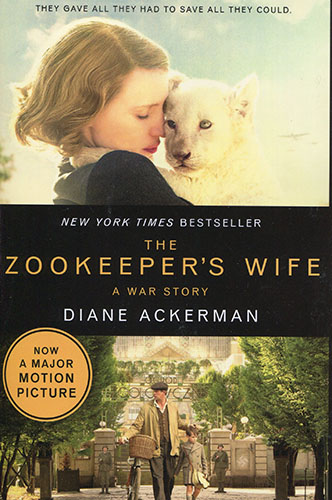
A Fierce and Gentle Heroine: review of THE ZOOKEEPER'S WIFE: A War Story


Diane Ackerman
$15.95 (our price $12.76) paperback


I first read an essay by Diane Ackerman in The New Yorker in 1988 titled simply “Bats.” Her humor, empathy, research, and unique turn of phrase led me to find other works by her, all of which I’ve read with relish. Her work never disappoints, bringing a warmth and style that just cannot be imitated or duplicated. She has a scientist’s eye for detail and a poet’s ear for phrasing. Her descriptions of the German invasion of Poland in The Zookeeper’s Wife, are poignant and memorable, bringing the crumbling buildings and hollow-eyed inhabitants to vivid life. Each animal, each person, has his or her own story to be told, and their narratives are displayed in full color. The movie based on this book will, I hope, bring an even larger audience to Ackerman’s works.

Ackerman relied on Antonina Zabinski’s own writings as well as diaries and interviews of survivors of the Warsaw Ghetto, to tell the story of the Warsaw Zoo and its role as a haven for “Guests” who were escaping Nazi brutality. She addresses the important and controversial issue of the Nazi’s fascination with eugenics and their somewhat bizarre determination to preserve “pure” species of some animals. As in Elizabeth Letts’ The Perfect Horse, we witness both the horrific brutality of the regime and their strange protection of (at least some) animals.

Antonina and Jan Zabinski were ardent animal lovers, whose care for the most exotic as well as the more mundane of their creatures made the destruction of the zoo that much more heartbreaking. But rather than give up or escape with their young son, they chose to stay and risk their lives to save as many Jews as they could, hiding some in the empty cages, where secret passageways connected to the villa so that food could be smuggled in to them, and playing elaborate schemes to keep the Germans off track. Each Guest was given a new name, sometimes harking back to the zoo’s original purpose; thus an artist who particularly loved birds was renamed Starling. Sometimes the names were just intentionally Christian. The change of names was just one more dent in the Jewish identities, but was a necessary and at times life-saving practice. The animals, too, were all named. A hamster named Piotr (Peter), for instance, became the close companion to one guest, Maurycy Fraenkel, called Pawel (Paul). Such friendships brought some levity into a dark time:

“After supper each evening Maurycy turned Piotr loose on the table’s polished mesa, where the hamster skittered from plate to plate, whisking up crumbs until his fat cheeks dragged. Then Maurycy would gather him up in one hand and carry him back to his cage. .  .  . the pair became inseparable, and villa-mates began referring to Pawel and Piotr collectively as ‘the Hamsters.’”

Jan Zabinksi left each day to a job that provided adequate cover for him to extract more people from the Ghetto and to distribute food to the starving. Each day Antonina cared for the hiding Guests, her young son, and the few animals they managed to save. “[She] was a housewife,” Jan is quoted as saying. “[S]he wasn’t involved in politics or war and was timid, and yet despite that she played a major role in saving others and never once complained about the danger.” It was her intense understanding of animals, he believed, that gave her the strength to stand up to mortal danger. “[F]rom time to time she seemed to shed her own human traits and become a panther or a hyena. Then, able to adopt their fighting instinct, she arose as a fearless defender of her kind.”

In the course of the war, Antonina became pregnant and was bedridden, and yet still managed to protect those in her care. When her baby was born, her fierce protectiveness was all the more in evidence. She was gentle, soft-spoken, always questioning herself, and yet she never faltered, no matter how terrified, when standing up to the enemy.

The ever-present vigilance required to stay alive was exhausting. Most of those that did survive, did not live to a ripe old age. Four years of war scraped twenty years or more off their life spans. Consequently, we are seeing now the last of the witnesses leave us, and soon will have to rely on accounts such as this one to remember the mass psychosis of the Nazi era. Without knowing the history as intimately as possible, we will always face the possibility of another insane ideology taking root.


This account of true and honest heroism is uplifting and inspiring, but also a grim reminder of how the world can turn tipsy below our feet under the right—or wrong— circumstances. Can we afford to cater to leaders who are ignorant or dismissive of this history? Antonina Zabinski would most certainly shudder at the thought.


Friday, March 17, 2017

HUGE!—Review of GIZELLE'S BUCKET LIST, Lauren Fern Watt


Gizelle’s Bucket List: My Life with a Very Large Dog

Lauren Fern Watt
$24.99 (our price $19.99)

     OK, get out the tissues. Memoirs of loving and losing a special companion are tear-inducing, of course, and Lauren Fern Watt’s tale of her English Mastiff’s rich but short life is right up there with Marley & Me in that regard. But there is a lot of laughter, too, and a great deal of empathy for this young woman’s foray into adulthood, with all of its awful pitfalls. She was fortunate to have an enormous companion by her side during those dicey days sliding from teens to twenties, and from school to the workplace.

     As a puppy, Gizelle (named after Princess Giselle in Enchanted) was obviously bound for greatness, with paws the size of baseball gloves, but just how large she grew was still awe inspiring. And like the Great Dane in The Ugly Dachshund, Gizelle seemed oblivious to her giant size:

She was our resident bulldozer, spilling coffee and knocking over frames with her tail. And if my sister and I were snuggled on the small two-person love seat in the living room watching a movie, Gizelle was blind to the fact there wasn’t space for her, too. She would always make room for herself, stealthily placing one paw up and then another paw, then a graceful launch of 160-something pounds of her and finally a dainty landing into our laps. . . . She wore a smile, her mouth open as she panted, as if she thought: They do not even know I am here.

     Lauren Watt was brought up in a suburb of Nashville, in a family that was constantly sidelined by her mother’s addiction to drugs and alcohol. Growing up with an addict kept Lauren on edge, never sure what to expect. But it was her mother’s love of dogs combined with her impulsive nature, even when sober, that resulted in Lauren finding Gizelle. With two dogs already in the household, Lauren chose to lie to her father about the sudden appearance of a robust puppy. She told him the puppy was a lab mix and just a foster, not a permanent addition. “Is it me, or is she growing kind of fast?” he asked, but accepted his daughter’s word. Of course, he discovers the truth, but by then he had witnessed the bond between his daughter and the rapidly growing pup, and after a mild scolding, agreed to help take care of Gizelle while Lauren was in college.

     Taking care of Lauren’s mother, however, proved too much for everyone. Rehab never seemed to hold for long. Briefly, the mother she loved would return and life would seem perfect. But before long, the addiction took hold. And returning home from college, Lauren again found her mother undone. It seemed to be a last straw for her. She packed up Gizelle and left Nashville, determined to find her way someplace grittier, livelier, and more cosmopolitan, and away from the constant tension of home. She moved to Manhattan.

     Just as Giselle, the princess in Enchanted, pranced through Central Park, so it seems fitting that her canine doppelganger should also romp through the City. But Gizelle the 180-pound muscle-bound creature, who startled pedestrians and drew repeatedly ridiculous comments (that’s a T-rex, not a dog!) was frightened of the city noises, and cowered every time she heard a horn or saw even something as innocuous as a balloon on the sidewalk. And the only apartment Lauren was able to find that could house a super-size dog and not cost a small fortune was right smack in Times Square. Thus, she nicknamed their new home Times Scare, and struggled to find her own footing while reassuring her intimidated dog that nothing would hurt her. (Managing the bathroom habits of a giant dog in a city was equally challenging and particularly humorous.) Gradually, both Lauren and Gizelle learned to love the City. New friends are made, good jobs are found. So long as Lauren ignores her slowly dissolving home in Tennessee, she can keep moving forward, a mastiff by her side. When Gizelle begins to limp, Lauren can no longer hold panic at bay.

     You know the fairy tale has to end, but it is heartening to read of the author’s personal growth as she devotes her life to making Gizelle’s diminishing days as good as they can be, writing the bucket list of things she feels Gizelle would enjoy: trips to New Hampshire and Maine to jump in leaves, walk in sand, eat ice cream, and watch the snow fall on the beach. Gizelle seems to love all of the activities Lauren plans, but most of all, Gizelle simply loves being with her human companion. It’s through Gizelle that Lauren herself learns about forgiveness and empathy.


     So yes, keep the tissue box handy, but as the items in Gizelle’s bucket list are ticked off, you will find yourself inspired and humbled by Lauren’s devotion and Gizelle’s courage. We all generally outlive our animal companions. If they manage to teach us something before they go, that is cause for celebration, not sorrow.