Monday, March 23, 2015

Healing Horses: review of RIDING HOME, by Tim Hayes


http://booksforanimallovers.com/new-releases/398-riding-home-the-power-of-horses-to-heal.html


Hardcover, $20.79 SMP; 2015
Tim Hayes
Foreword by Robert Redford

Tim Hayes came late to horsemanship, relatively speaking. Most riders have their first experiences with horses as children, and are able to learn to trust the huge animal they are sitting upon with unquestioning confidence, but without really understanding the nature of the relationship. Hayes was in his late forties when he began working with horses. It seems remarkable that he was able to find that childlike wonder so late in life. But then again, that’s part of what Riding Home is all about: rediscovering that wonder, or, in the case of a dysfunctional childhood, creating a new sense of wonder, health and contentment, all through working with horses.
A child with severe autism, a veteran with PTSD, a troubled teen, a prisoner with a violent past—Hayes relays several actual cases of recovery and psychic resurrection thanks to the powerful horse/human bond, and he explains the mechanisms at work behind this unusual alliance.
The fact that a horse can assess a person’s state of mind and mirror it is not magical or supernatural. It is based on the horse’s own place in nature as a prey animal, always hyper-vigilant in maintaining his own safety and comfort, and adhering to the laws of the herd. And yet, when a child with autism sits upon this sensitive creature and feels safe enough to speak out loud for the first time, the result does seem magical indeed. Horses (and other animals, too) offer unconditional acceptance. They do not judge past actions.  They are not concerned with your appearance, but only with your demeanor in relation to them.
Hayes tells the story of one Iraqi War veteran, Cody, who turned to Hearts and Horses for help when traditional therapies were not successful in treating his PTSD. He was paired with a horse named Dusty. Cody asked his equine counselor why Dusty periodically pinned his ears and seemed distrustful of him when he approached. The counselor asked if he was anxious and he admitted he was, in fact “all of the time.” She suggested then that he was making the horse anxious, and that Cody stand next to Dusty, stroke him, and just breath. Gradually, both Dusty and Cody relaxed, and soon their relationship became a bond built on trust. It took time, but as Cody tells it, the result was amazing:
I’ve been riding and hanging out with Dusty for about a year. I feel a sense of accomplishment—my health is definitely not in the clear, but it’s in my rearview. What’s really incredible is my trust. When I came home, I couldn’t trust anybody or anything. Dusty got some of it back for me. It’s like he brought me home.
Hayes writes well about natural horsemanship, explaining elements of training for the novice as well as the seasoned rider. Experienced horse people will find much to gnaw on here; there are many ways to explain developing “feel” when riding, but it can still be a vague and arbitrary term. Hayes’s explanations are plausible and straightforward, and will have equestrians nodding in agreement, and wannabe riders Googling horse farms!
The book includes an appendix, listing various equine therapy organizations, an index, and extensive bibliography. This is a fine addition to any horse person's library, and to the literature of animal healing.


Sunday, March 8, 2015

Schnauzer's Rights: Review of LAWYER FOR THE DOG: a novel


http://booksforanimallovers.com/new-releases/394-lawyer-for-the-dog.html


Lawyer for the Dog: a novel

Lee Robinson

Thomas Dunne; Available July 7, 2015

HC 24.99; 240 pp

9781250052414


The author of this delightful novel practiced law in South Carolina for twenty years and knows the ropes. So her protagonist, the super sharp Sally Baynard, is perfectly drawn. Pushing fifty, divorced from Judge Joe Baynard, of the elite Baynard family in SC, coping with her mother’s advancing Alzheimer’s, and struggling to build up a small practice in family law, Sally is just barely keeping the balls in the air when her ex-husband the judge pulls a fast one.
A divorce case is being held up because of one big bone of contention: Sherman, a miniature schnauzer whom both husband and wife adore and claim as their own. Judge Baynard assigns Sally as the dog’s attorney/guardian. But is he really just trying to win her back as his second marriage falters? Sally doesn’t believe so, and also doesn’t really know what to do with a dog, but before long, Sherman wins her over and she becomes more and more entangled in the bitter custody battle, and more and more in love with the little pup.
And meanwhile, Sherman’s veterinarian turns out to be a charming and available fellow who just might change Sally’s views about the benefits of staying single.
Robinson’s writing is swift and lively, making this a fun, fast read. It's particularly refreshing to read a novel featuring a woman of a certain age without the tired stereotypes or feeling of marginalization. Sally Baynard is a great character, and one who deserves to be revisited again. Let's hope this first novel is just the beginning.
Available for pre-order at www.booksforanimallovers.com.

Friday, March 6, 2015

A Tragedy of Mammoth Proportions: review of THE LAST CHAIN ON BILLIE


http://booksforanimallovers.com/dev/nonfiction-bio-memoir/173-last-chain-on-billie.html?search_query=last+chain&results=1

 The Last Chain on Billie

Carol Bradley

SMP; 2014

Extinction is a terrible word. We’ve been hearing warnings of it for at least two centuries, but still have watched species disappear, or be reduced in number to an irrecoverable point. And now, we are quite possibly doomed to witness the end of the elephant.
The cause is not natural: It is human greed, pure and simple. That is, in fact, the cause of so many natural catastrophes we are seeing now. The desire for ivory, and the harvesting of palm oil are two of several causes leading to the decimation of elephants and other creatures faster than anyone can stop. The acquisition of baby elephants for exploitation by zoos and circuses is another nail in the elephant coffin. Their abuse for our entertainment has been chronicled, but their rescue and protection are still slow to come.
Elephants are practically synonymous with the circus. Any animal lover certainly understands that forcing an elephant to stand on her head, or a tiger to leap through a burning hoop, are not activities done at the animal’s discretion.  But we are told the animals want to perform, that they enjoy obeying their handlers’ commands, and we want to believe the lie. As Carol Bradley writes in LAST CHAIN ON BILLIE, nearly all elephant keepers believe the animal must be beaten hard in order to keep the handlers safe. The consequences of repeated beatings often were dangerous “rogue” elephants who killed their attackers and occasionally innocent bystanders.  They simply had been beaten one time too many and could not longer contain their fury. One young elephant actually lay down and sobbed after trying desperately to please her trainers who continued to whip her. The animals suffer from post-traumatic stress, and become emotional cripples. And it’s true: they never do forget.
Bradley writes that by the mid-1980s, groups such as PETA and whistleblowers within the circus industry were publicizing the mistreatment of circus animals. They had hard evidence: videos of horrible abuse and neglect of these magnificent creatures. “Activists urged circus-goers to understand that the only reason elephants scrunched their feet up on tubs and stood on their heads was because they were frightened and intimidated into performing…”  The message spread.  In 2001, The New York Times called circuses “the interspecies version of a minstrel show,” and declared them out of step with the more enlightened entertainment available today.
Billie, an Asian elephant, was one of the famed Hawthorne Five belonging to the now notorious circus owner, John F. Cuneo. The circus life she was forced into was brutal, unnatural and often deadly. She was referred to by most of her trainers as difficult, and treated with hatred and violence for decades. Mr. Cuneo himself has wracked up a long list of penalties and lawsuits over the last twenty years due to his abusive and neglectful handling of animals. Enforcement of animal welfare laws, however, is weak and ineffective. Cuneo managed to delay proceedings long enough to be fatal to some of his elephants (and other animals as well). But that didn’t matter to him. His reason for having animals has always been to make money. So again, greed is the compelling force behind cruelty.
Thanks to the Endangered Species Acts in the 1970s, animals who were otherwise considered disposable became much more valuable, and therefore less likely to be executed for bad behavior. But that did not stop of horrific abuse. When whistleblowers began to bring suit against Ringling Bros. and Barnum & Bailey owner, Kenneth Feld, he went to great lengths to destroy the reputation of his attackers, rather than to ensure the health and welfare of his circus’s inmate elephants. The elephants make more money for Ringling than any of their other enterprises. Felt simply will not give up the profits just for ethical treatment of elephants.
Zoos have instigated huge PR campaigns to persuade the public that they serve as important safeguards for endangered wildlife. In truth, some of that wildlife would be less endangered without zoo acquisition. The manner in which they’d come by elephants was brutal enough. But many zoos have attempted to provide an improved facility, and have rescued former circus elephants who became too beaten down to continue entertaining.
Billie’s story is tough to read, even though it does have a happy ending.  Her rescue was one of the successes, thanks to the Elephant Sanctuary. Other animals have been rescued by Pat Derby’s PAWS and other dedicated, hard-fighting folks who will not give up the war against animal abuse. But it is imperative that every animal lover does read about Billie and that the names of some of the biggest culprits remain forever forefront: John F. Cuneo, Kenneth Feld, and dozens of circus owners and handlers who have repeatedly thumbed their noses at the animal welfare laws and continue to mistreat and exploit this magnificent creature are exposed here in all of their ugliness. John Cuneo continues to enjoy a life of leisure and splendor that his brutal exploitation of elephants and other wild animals has provided. His name should be synonymous with animal cruelty, not with Loyola University’s Cuneo Hall.
The best thing we bystanders can do is keep spreading the word, stay informed, and support those who are in the fight as much as possible. More important, we should no longer accept the use and abuse of wild animals for profit. Circuses are not “good, wholesome family entertainment,” as Kenneth Feld proclaimed. They are dark, dank pits of violence and cruelty. If the audience stops paying, perhaps the cruelty will finally end.
Go to elephantsanctuary.com for more information about their wonderful work. And to Performing Animal Welfare Society or PAWS at www.pawsweb.org. And when the circus comes to town, think of Billie.

Thursday, February 26, 2015

Review of HOLY COW, by David Duchovny


http://booksforanimallovers.com/dev/home/388-holy-cow.html

This first novel by actor David Duchovny is, as would be expected, outside of the box. It is a fable, narrated by Elsie Q., a milk cow on a small farm in upstate New York.
As the tale begins, Elsie discovers the brutal truth about what happens to cows on farms, possibly her farm too, and worse, what likely happened to her mother, who had simply disappeared one day.  She also learns that in India, her kind is worshiped, and live out their lives in comfort and safety. So obviously, she must go to India. What could be better than being worshiped as a holy being? Accompanying her on this excursion is Jerry (Shalom) the pig, who believes going to Israel will save his life, and Tom the turkey who has determined the country named after him would obviously not be serving turkey as food. This bizarre trio manage to secure passports and tickets and board a plane to the Middle East.
Okay, so suspension of disbelief is obviously indispensable here, but that’s really not the point. This book is hysterically funny, and also satirically wise. On the surface Holy Cow presents a sort of “follow your dream” message; but not far beneath it is a condemnation of human animals for their cruelty and abuse of two- as well as four-footed creatures, and a plea for resolution to the conflicts exploding in the Middle East:
“The Israelis built this giant wall to keep Palestinian Arabs out of the disputed lands they were claiming for themselves. It reminded me of the fences back on the farm that were meant to keep us animals in our place. There is something in man that loves a wall, but what wall menders and fence builders do not get is that when they fence something out, they are also fencing themselves in.”
All of that is wrapped up in a healthy dose of silliness that does not diminish the seriousness of Duchovny's message. The primitive drawings complement the romping tale perfectly.
The first half of the book is written in the style of a screenplay because Elsie is pushing for movie rights to her book. She points out product placement and contemporary cultural references that her editor tells her will broaden her audience. It’s clear Duchovny had loads of fun poking at the publishing and entertainment industries while spinning his yarn. It is also clear that Elsie is one helluva cow, holy or not.
For more cow books, see Ask the Cow, by Rita Reynolds, and My Gentle Barn, by Ellie Laks.

Friday, February 20, 2015

A True Lone Wolf: review of A WOLF CALLED ROMEO


http://booksforanimallovers.com/animals-nature/37-a-wolf-called-romeo.html

Houghton-Mifflin, 2014; $26


The author of this extraordinary true story is a gifted wildlife photographer and nature writer living in Alaska. Nick Janis seeks to tell the story of the black wolf with accuracy, equanimity, and forthrightness. But his love for the wild creature who befriended his dogs and those of other residents of Juneau, and even forged relationships with some humans, is as deep as the Alaskan winter snow.
The story began one afternoon when Janis was skiing on the frozen Mendenhall Lake and spotted the unmistakable tracks of a wolf. In the ensuing days, he finally met the enormous lone male wolf, whom his wife later nicknamed Romeo, and began the now legendary years of interaction between the wild and the so-called civilized.
As Janis notes, and as anyone who cares about wildlife understands, wolves have had the short end of humanities’ stick for centuries, being blamed for destruction they have not caused, and feared for violence they would not commit. The malignancy of wolf hatred has not abated. Even a vice-presidential contender bragged of her support of aerial wolf hunting, and Alaska in particular has defended the rights of hunters to eradicate competing predators, i.e., wolves and bears. Biologists overall have concluded that such intrusion will not have the desired effect, but that doesn’t stop the bloodlust.
So why, in the midst of an anti-wolf world, did this enormous fellow decide he wanted to make friends with domestic dogs and even a human or two? The theories abound, as does the controversy. Romeo becomes a local celebrity, inspiring crowds of onlookers, some of whom have questionable common sense and others even more suspect intentions. Every autumn that Romeo returns to the glacier, Janis worries that it will be his last. With so much attention focused on him, there is bound to be someone out there itching to bring him down.
One silver lining in Romeo’s tale is the group of friends who come together over his welfare and do their best to protect him. The bond that forms among the humans and between the wolf and the community is almost metaphysical in its intensity. There truly does seem to be something supernatural at times about Romeo. Janis observes him even walking on water: “At last the wolf stepped forward—not into the water, but onto it—and as I watched, he trotted across the lake, each step raising a silver-white plume and the spreading vee of a wake to mark his passing. At the far side, the wolf paused, a shadow among shadows, and merged into the night.”  Of course, the wolf was actually walking on two feet of ice beneath water from a recent thaw. But the image is unforgettable.
Although little is understood about Romeo’s behavior, it is possible that a black wolf hit by a car, pregnant with four puppies, may have been his mate or his mother, leaving him alone. His urge to have his own pack perhaps inspired his friendships with the domestic dogs. Sex didn’t seem to enter into it, since he was friendly with neutered females and males alike. Small dogs did pose a problem, however; he seemed to view them as possible prey, and was accused of killing a beagle. (Evidence never did prove him to be the culprit, but in a wolf’s world, he is considered guilty unless proven otherwise, sometimes even if proven otherwise.)
Because Romeo was thoroughly wild, without any food conditioning or previous captivity to explain his friendliness, his behavior was astounding, and offered a unique opportunity to view the wild culture he inhabited. His curiosity, empathy, and yearning to connect opened that door. Fortunately, we have people like Janis around to keep the door ajar. 

Thursday, February 12, 2015

A Brazilian Odyssey: review of BLOOD-DRENCHED BEARD, by Daniel Galera


http://booksforanimallovers.com/new-releases/385-blood-drenched-beard.html

In some ways a murder mystery, in others an exploration of immortality, and further, the story of a man and a dog, this novel by the gifted young Brazilian writer is above all richly evocative.
The hero, unnamed, but referred to at times as Swimmer, Tom Hanks, and Gauderio (after his grandfather, to whom he bears an exact likeness) goes on an odyssey with his father’s dog, in search of the truth of his grandfather’s death. He’s a triathlete and expert swimmer, who finds solace and restoration in the ocean, but also terror.
The novel begins with his father’s declaration of imminent suicide, and his dying wish that his little dog Beta be euthanized after his death. He doesn’t want her to suffer his absence. He also tells his son about the murder of his own father apparently at the hands of the villagers of Garopaba, a quiet and beautiful beach town on the Atlantic coast of Brazil. The group murder is reminiscent of Agatha Christie, and strikes our hero as possibly fictional, and totally irresistible.
His father makes good on his suicide decision, but his son refuses to have Beta put down, instead taking the elderly dog with him on his search for the truth about his grandfather.
Due to a rare condition of facial amnesia, he is unable to remember people’s features, which leads to awkward moments at best, and violent reactions at worst. He finds that the quiet little beach town is anything but, and that residents’ claim of peaceful existence actually hides a dark history. As he asks questions about his grandfather, he’s met first with startled silence, then suggestions that he not delve any deeper, and eventually with threats. And as summer retreats, the ocean grows colder and grayer.
The novel is written in a rhythm not unlike the waves that crash just outside the narrator’s door. The ocean is a Greek chorus to the narrator’s journey. There are long stretches of calm rumination that change to sudden explosions. Beta becomes a dolphin-like swimmer, gaining strength and life after an accident had nearly crippled her. At that time, the ocean offers salvation. But when the dog is in jeopardy, the storm-churned waters become rabid, and murderous.
 Although this isn’t a dog book, per se, the character of Beta is as important as any of the people, and in some ways, more so. Beta’s is one face the narrator seems to actually recognize, and his devotion to her is what leads to the title of the book: an unforgettable moment of explicit violence and dark humor.

Tuesday, February 10, 2015

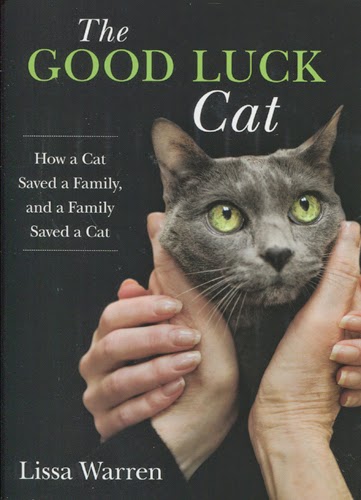
Love, Loss and Family: review of THE GOOD LUCK CAT, by Lissa Warren


http://www.booksforanimallovers.com

A cat’s devotion is hard won but unbreakable, as anyone who has ever loved a cat will attest. True, they demonstrate their loyalty differently from dogs, but it is loyalty all the same. Each of the ten felines I have shared my home with over the last fifty years has had his or her own way of fitting into my life, as if each were the missing puzzle piece I’d been searching for.
The good luck cat of the title of this lovely and heartfelt memoir is Ting-Pei, a Korat, which in Thai means “good luck.” She is brought into the Warren household by Lissa and her mom to give Lissa’s retired dad a companion, one who would entertain him while the women were away at work. Ting turned out to be the perfect fit, and Lissa’s father adored the little cat. In fact, all three became Ting’s ardent admirers, protectors, and defenders. Ting could do no wrong, even when she did.
But good luck didn’t hold out quite as long as hoped. Lissa’s father became ill with heart disease, and eventually succumbed, leaving three grieving souls behind: his daughter, his wife, and his cat.
When Ting herself developed a heart condition at age fourteen, Lissa and her mother were determined at all costs to heal her. It was as if losing Ting would have been akin to losing her father all over again. Surgery ensues, and then the endless battle to protect stitches from a cat’s relentless tongue. Mother and daughter even buy onesies for babies and try to wrap Ting up to protect the incision:
“As for me, I’m not unaware that I’ve become a thirty-six-year-old single woman who lives with her mom and dresses her cat in baby clothes. But I don’t care. I’ve shimmied far enough up Maslow’s hierarchy that it doesn’t much matter what others think about me. All I want is for Ting to be well…..”
As Ting improves and moves happily into older age, Lissa finds herself undergoing tests and fighting down fears as she feels something amiss in her own body. Illness is bearing down on her, but it will not quash her optimism, which seems to be the gift of her late father, and one she cherishes and honors.
Warren writes with unapologetic zest about cats in general and her cat in particular. Her family is atypical in many ways, and she’s quite aware of that. But the intensity of their devotion to each other is enviable and really, these days, maybe extraordinary.
The good luck Ting has brought to the Warrens may not always seem evident, but it is there, part of the little grey ball of fur, seeking out the swath of sunlight on the carpet, and purring as if life depended on it. And maybe it does.